Auto-Overfit: Measuring and Reducing Overfitting in Autoresearch
In Karpathy's autoresearch, an LLM agent edits train.py and accepts or rejects the edit based on a validation metric on a holdout slice in a loop.
The structural worry is adaptive holdout reuse1, as every accept/reject decision leaks information from the val set into the agent's trajectory, even if the val set is different from the train set. After many experiments, val error behaves like train error. The original autoresearch repository had a crystal clear example in autoresearch issue #131: the last accepted "win" turned out to be a random seed change.
I also noticed in my own quantitative research projects that this pattern was a problem. For instance, given a canonical basketball analytics problem like RAPM (predicting the points scored on a possession given the 5 offensive and 5 defensive players), an autoresearch agent started creating features out of pairs of players, a clear overfitting signal on a small dataset. Unsurprisingly, it reduced error on the val slice but not in test.
This study measures the effect on tabular ML tasks from OpenML2 with an XGBoost baseline3. The most interesting findings are:
- The basic autoresearch loop overfits to validation wins that do not show up on test. Val improved +0.019 while test moved ~0 (-0.0006) on average. The val-test gap is +0.020 (paired p = 0.001).
- Requiring a significant effect size to beat the validation noise floor fixes most of the problem. Accepting only changes with Δval > 1·σ_val cuts the mean overfit gap to +0.005 (p = 0.004) and flips mean Δtest from -0.0006 to +0.003. The Δtest improvement alone is not significant at n = 15 (one-sided p = 0.06) but the gap reduction is.
- Asking the LLM to reflect on the source of overfitting did not help. Showing the proposer train/val diagnostics and asking it to avoid likely noise wins produced gap +0.021 (p = 0.75) and Δtest -0.003, neither statistically different from the plain val-gate baseline.
Harness
Each of the 15 OpenML classification tasks runs as its own independent autoresearch loop. Per-task isolation means each loop owns a separate train.py, experiment history, and LLM conversation - they never see each other's results. Each task is stratified into a 65/10/25 train/val/test split with a fixed seed.
Baseline. An untuned XGBClassifier with library defaults. The file is deliberately thin, so there's lots of obvious room for the LLM to mutate (learning rate, depth, regularization, feature engineering, etc.).
Proposer. One live Sonnet 4.5 call per experiment. Each turn the prompt is a fixed system preamble naming the task, what the agent may and may not mutate (split, prepare step, test slice), the current train.py in full, and the last 10 experiments as a compact history (index, status, val_err, the LLM's own one-line description).
Val-gate. Strict accept iff val_err < best_val. Kept proposals overwrite train.py, discarded ones are rolled back.
Silent test slice. The test slice is held by the harness and never exposed to anything the agent sees. Every evaluation computes val and test error side by side, but the loop only ever receives val. Test error lands in a private log that no proposer, gate, or program rule reads, and an AST check on each proposed file rejects any reference to the test slice or that log.
Baseline autoresearch, the overfit phenomenon
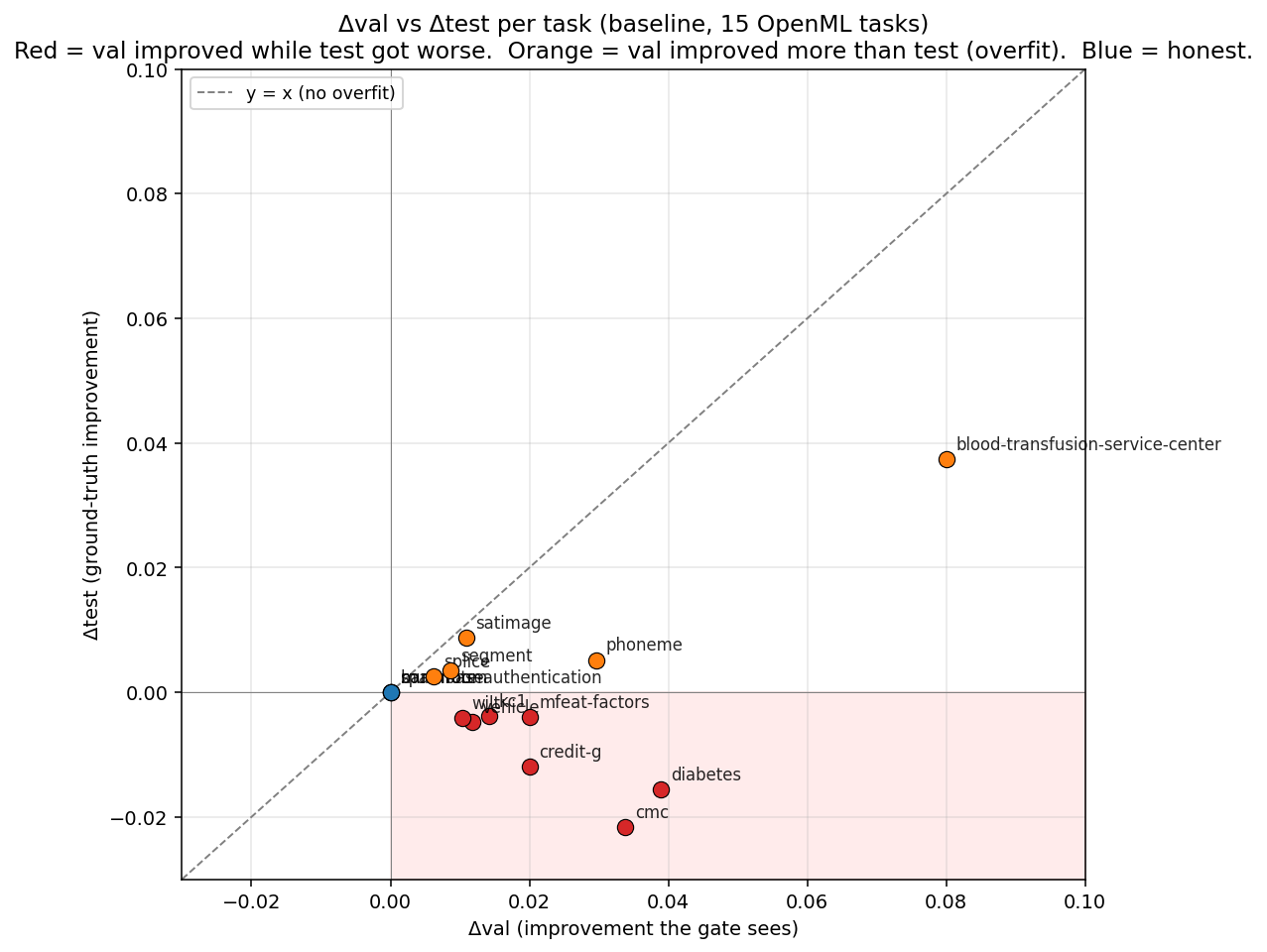
Each point is one task. The dashed diagonal is what honest progress looks like: val improvement matches test improvement. Orange points fall short of that line and red points fall below zero on test, meaning val improved but test actually got worse. That happens in 7 of the 12 tasks with any movement.
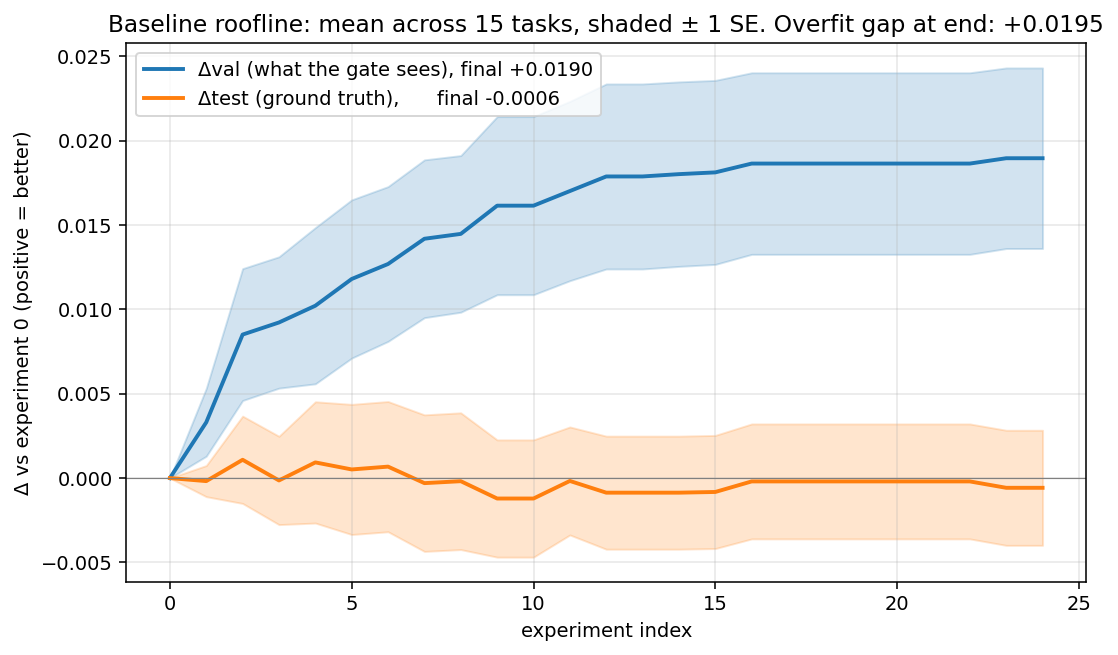
Averaged over 15 tasks, val descends as expected (blue) but test stays flat at zero (orange). The gap between the two curves is the adaptive-holdout overfit.
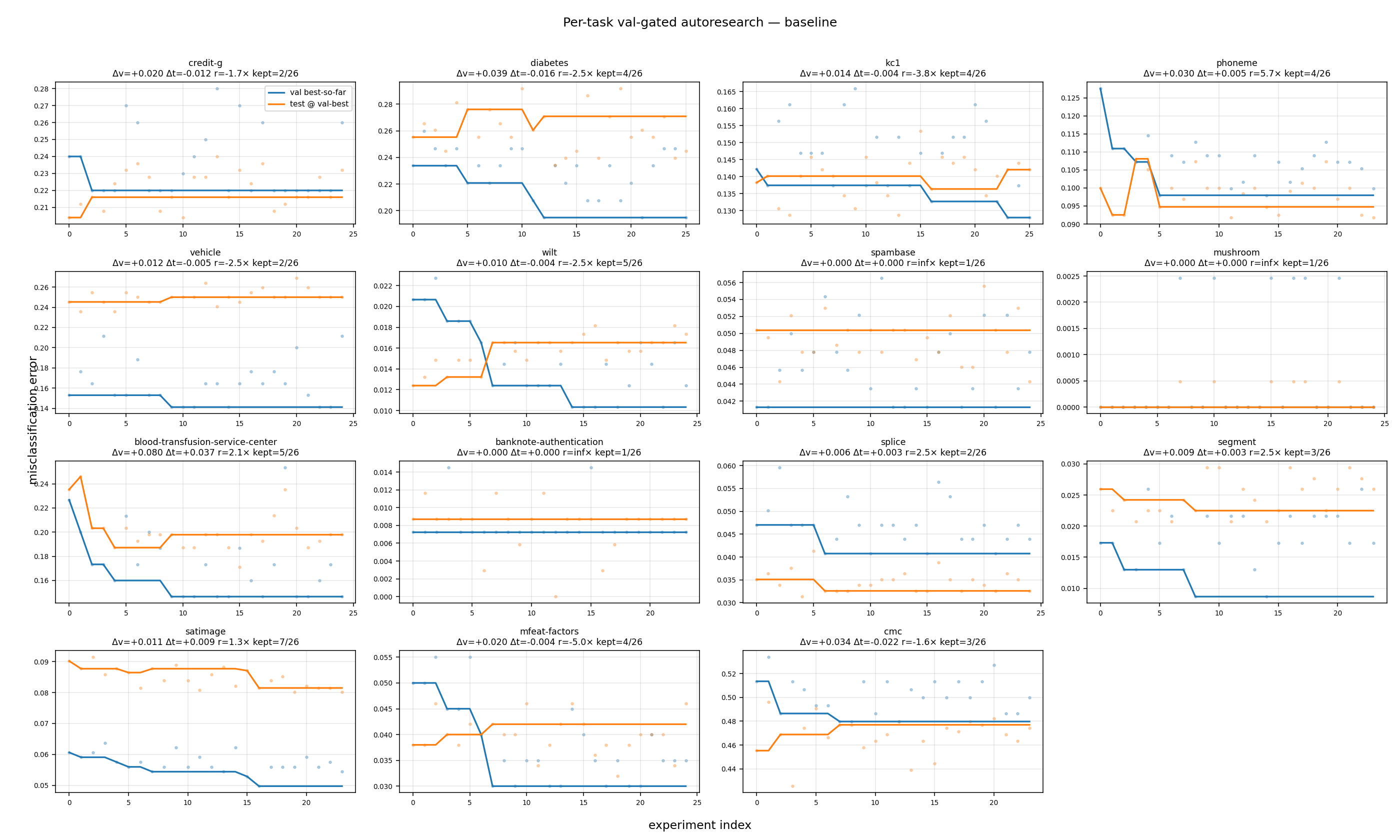
Per-task summary
Sorted by Δval / Δtest ratio (most honest first, most overfit last). The v/t column is this ratio: a positive value means val and test moved the same direction; a negative value means val improved while test regressed.
| task | n | kept | Δval | Δtest | v/t |
|---|---|---|---|---|---|
| spambase | 25 | 1 | +0.000 | +0.000 | no movement |
| mushroom | 25 | 1 | +0.000 | +0.000 | no movement |
| banknote-authentication | 24 | 1 | +0.000 | +0.000 | no movement |
| phoneme | 24 | 4 | +0.030 | +0.005 | 5.71x |
| segment | 24 | 3 | +0.009 | +0.003 | 2.50x |
| splice | 25 | 2 | +0.006 | +0.003 | 2.50x |
| blood-transfusion-service-center | 25 | 5 | +0.080 | +0.037 | 2.14x |
| satimage | 24 | 7 | +0.011 | +0.009 | 1.25x |
| cmc | 24 | 3 | +0.034 | -0.022 | -1.56x |
| credit-g | 25 | 2 | +0.020 | -0.012 | -1.67x |
| diabetes | 26 | 4 | +0.039 | -0.016 | -2.49x |
| vehicle | 25 | 2 | +0.012 | -0.005 | -2.49x |
| wilt | 25 | 5 | +0.010 | -0.004 | -2.50x |
| kc1 | 26 | 4 | +0.014 | -0.004 | -3.75x |
| mfeat-factors | 25 | 4 | +0.020 | -0.004 | -5.00x |
Aggregate overfit statistics
- Mean Δval +0.019 (95% CI [+0.010, +0.030]), mean Δtest -0.0006 (CI [-0.006, +0.006]).
- Mean overfit gap (Δval - Δtest) +0.020, paired-Wilcoxon p = 0.001.
- Of the 12 tasks with metric movement, 7 show val improving while test regresses (negative ratio). Only 5 show the honest pattern where val and test move together.
- Median val:test ratio across the 12 tasks with movement: -1.61x.
For example, an autoresearch user looking only at val would think they'd saved ~4% error on diabetes when the true test effect is negative (test got 1.6pp worse). On 7/12 tasks the val-only reader thinks they've improved the model when test error has in fact increased.
Examples
Below are examples experiments where the LLM proposed an edit, the val-gate accepted it, and the silent test log showed it made things worse:
diabetesi=5, "Set subsample=0.8 and colsample_bytree=0.8 to add stochastic regularization". Val -0.013, test +0.021 (test regressed 2.1pp, 1.6x larger than the val "gain"). Accepted.cmci=2, "Lower learning_rate to 0.1 to improve generalization with smaller gradient steps". Val -0.027, test +0.014.credit-gi=2, "Reduce max_depth from default 6 to 3 to prevent overfitting on this relatively small dataset". Val -0.020, test +0.012.vehiclei=9, "Add reg_alpha=1.0 for L1 regularization to encourage feature sparsity". Val -0.012, test +0.005.diabetesi=12, "Set n_estimators=150 to allow more boosting iterations". Val -0.013, test +0.010.
Although most of the accepted fixes looked reasonable and none were as egregious as simply changing a random seed, the loop still encouraged a search over hyperparameters that overfit to val at the cost of generalization. For example the diabetes i=5 case is a standard regularization edit that lowered val by 1.3% but made test 2.1% worse, so it was a "win" under the val-gate and a regression under ground truth.
Mitigations
I experimented with the following mitigations to the overfitting problem4 along with a single representative setting per mitigation.5 Significance tests throughout are paired Wilcoxon signed-rank at n = 15 tasks.
| mitigation | what / why | cost |
|---|---|---|
| effect-size gating | Accept only if Δval > k x σ_val, where σ_val is the bootstrap standard error of val_err on the val slice. Small-perturbation noise wins are smaller than σ and get blocked. | Needs σ estimate (one extra model fit per task). Blocks some small wins. |
| thresholdout budget | [Dwork et al.] Add noise ~ Laplace(σ) to val_err, and only allow b "fresh reveals". Once budget is spent, the agent must rely on cached noisy answers. | Limits gate budget, gate becomes blind after b accepts. |
| rotating val | Partition the val slice into K disjoint folds; evaluate experiment i on fold i mod K with a per-fold running best. Memorizing a specific sample fails because each fold is only revisited every K experiments. | Per-fold val has higher variance than full-val, so the gate sees noisier signals. |
| top-K confirmation | After the greedy val-gated search finishes, re-evaluate the top K surviving candidates on a fresh re-sample and pick the best on the re-eval. Stops the run from committing to whichever candidate got the luckiest single val draw. | Post-hoc, easy to add. Shifts which experiment "wins" without changing the kept count. |
| reflection (proposer-side) | Fresh LLM loop. Each turn the agent is shown train_err, Δtrain vs Δval, running σ, recent-keep pattern. Asked to label proposals [real] vs [noise-avoid] and propose qualitatively different kinds of changes after a suspected noise win. | 1-2x prompt tokens, extra LLM attention budget. |
Comparison
Overfit gap (Δval - Δtest) per gate, averaged across 15 tasks. 0 = perfect generalization, positive = val-gate cheating:
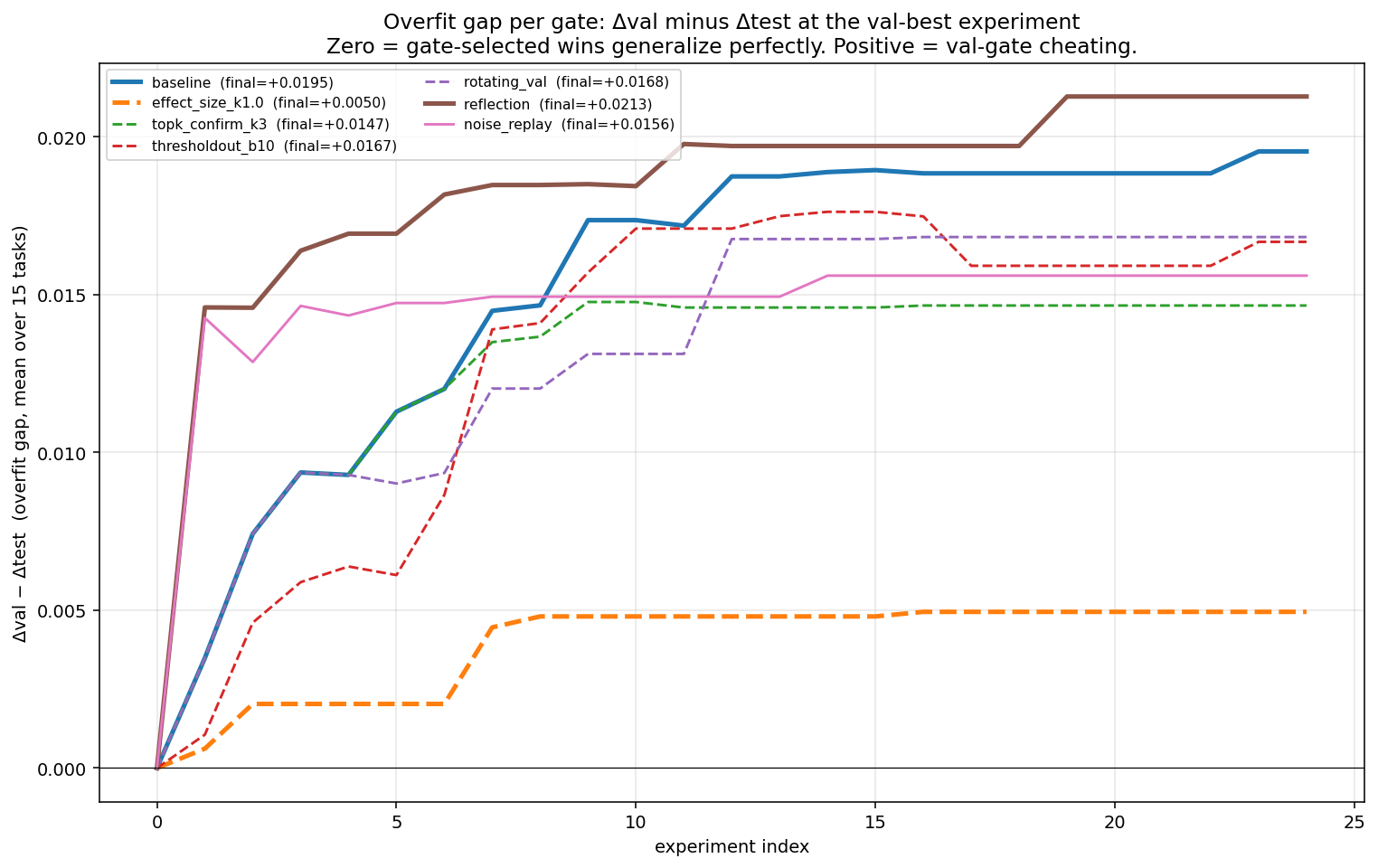
Absolute test_err at val-best per gate:
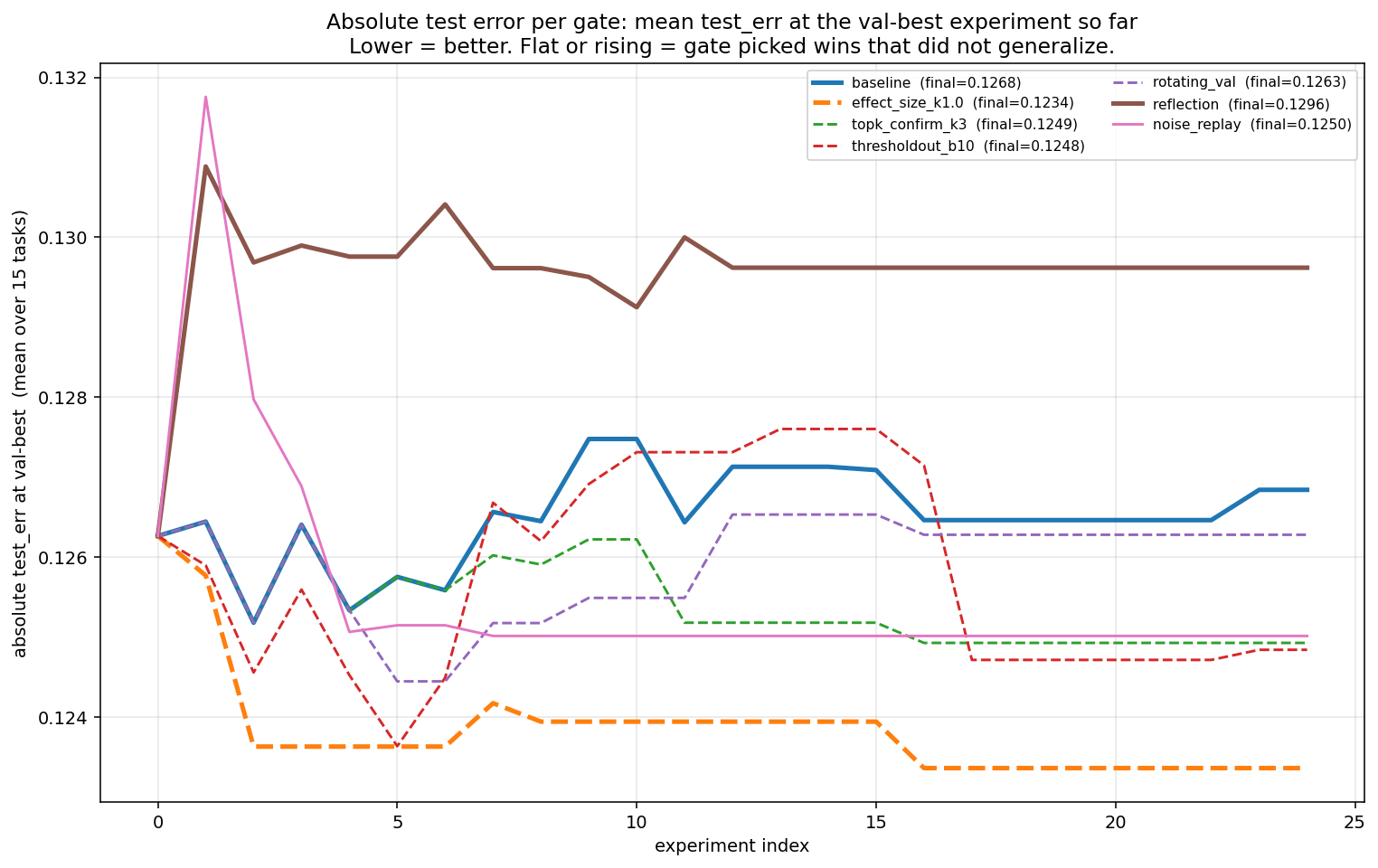
Summary table with paired Wilcoxon signed-rank tests (one-sided) on the per-task overfit-gap reduction vs baseline:
| gate | median v/t | μ Δval | μ Δtest | kept / 375 | mean gap | p(gap < baseline) | sig α=0.05 |
|---|---|---|---|---|---|---|---|
| baseline | -1.61x | +0.019 | -0.001 | 48 | +0.020 | - | - |
| effect_size k = 1.0 (recommend) | +1.46x | +0.008 | +0.003 | 21 | +0.005 | 0.004 | yes |
| topk_confirm k = 3 | -0.14x | +0.016 | +0.001 | 48 | +0.015 | 0.023 | yes |
| rotating_val | -1.61x | +0.017 | -0.000 | 94 | +0.018 | 0.040 | yes |
| thresholdout b = 10 | -0.15x | +0.019 | +0.001 | 43 | +0.018 | 0.327 | no |
| reflection | -0.94x | +0.018 | -0.003 | 40 | +0.021 | 0.747 | no |
Mitigation analysis
Effect_size k = 1.0 is the cleanest mitigation because it only accepts wins bigger than the estimated noise floor: gap +0.020 -> +0.005 (p = 0.004), mean Δtest -0.0006 -> +0.003, no extreme overfit, and 21/48 baseline keeps survive. At n = 15, it prevents val-gated runs from hurting test rather than significantly improving Δtest.
Topk_confirm is nearly free because it lets the greedy search over-explore val, then makes only the final choice on a fresh internal holdout from train+val. It cuts the gap at p = 0.023, with keep count unchanged because it re-selects post hoc.
Rotating val tries to avoid repeatedly querying the same slice, but lands at gap +0.018 (p = 0.040), marginally significant, and accepts ~2x more experiments (94 vs 48) because smaller fold-val slices are noisier. Resampling val from (train ∪ val) per experiment would be cleaner, but breaks the "train is never touched" story. See Open Questions below.
Thresholdout b = 10 tries to spend a limited budget revealing true val only when noisy val looks promising, but did not help (p = 0.33): the budget burns out in the first ~10 accepts, then noise wins slip through. Results are also sensitive to the Laplace noise scale.
Reflection gives the model σ and "last win looks like noise" signals before it proposes the next edit, but did not reduce the gap (p = 0.75) and trended worse on Δtest (p = 0.17, one-sided). My guess: those warnings make it more confident its next plausible regularization edit is real.
Conclusion
Val-gated autoresearch produces convincing-looking progress without corresponding test improvement. In this XGBoost harness, the LLM mostly proposed reasonable hyperparameter edits, not obvious hacks. Reusing the same val slice still turned val into something the loop could overfit.
The fix that worked was not asking the LLM to reason harder about overfitting, but making the gate less credulous. Requiring Δval > 1 · σ_val closed most of the val-test gap (p = 0.004). A post-hoc top-3 re-selection on a fresh internal holdout closed it further. Reflection, multi-seed averaging, and rotating val each either didn't help or came with costs that cancelled out the gains.
The effect-size gate is a simple change at the accept/reject check: estimate σ_val once via a bootstrap of the val slice, then accept only if val_err < best_val - k * sigma. No extra model fits in the hot loop, no budget bookkeeping, no prompt or context engineering. If you run autoresearch over many experiments on a fixed val set, do this.
Open questions
25 experiments per task is short. Dwork's bounds1 predict the overfit gap grows roughly as log of the number of adaptive queries, so whether effect_size k = 1 still fixes the baseline at 200 experiments is an open question.
Does this generalize past tabular XGBoost classification? Other models and tasks have different stochasticity profiles and proposal spaces. The overfit-gap metric and the effect-size fix should port cleanly, but the magnitudes may not.
Bonus: pure-noise replay
As a sanity check, we replaced the LLM with a deliberately uninformative proposer. After a few ordinary XGBoost hyperparameter changes, the script proposes only random-seed changes. These seed swaps should not contain real modeling insight, they mostly give the validation set another chance to be lucky.
The result is the clearest version of the failure mode. The val-gate accepted at least one seed swap on 15 / 15 tasks, for 37 accepted seed swaps total. The pure-noise replay improved validation by +0.017, close to the LLM baseline's +0.019, and the difference was not statistically significant (paired Wilcoxon p = 0.17).
This illustrates that the problem is not just bad LLM judgment. When the same validation set is reused many times, even meaningless proposals can eventually look like wins.
1 Dwork, Feldman, Hardt, Pitassi, Reingold, Roth, "Preserving Statistical Validity in Adaptive Data Analysis" (2015).
2 OpenML.
3 Tunguz, "XGBoost is All You Need" (2025).
4 Baseline-choice matters: untuned XGBoost is a strong baseline with little real headroom, so a larger fraction of kept experiments are noise. On a weaker baseline the overfit fraction would be smaller.
5 Full sweeps (effect-size at k in {0.5, 1.0, 2.0}, thresholdout at b in {3, 5, 10}, multi-seed averaging at M in {3, 5}, train-val agreement at τ in {0.005}) are available in the replay code; the reported setting is the one that best trades kept-count against gap reduction in preliminary sweeps.